Showing posts with label family. Show all posts

Saturday, August 14, 2010


Grandma had a Frigidaire like the model advertised in this video clip. It was older than me and when Grandma moved out of her big house in 1984 we took the fridge and put it in our basement. We sold it in 1987 when we moved to another house and I wouldn't be surprised if it is still humming along keeping someone's drinks cold on this hot summer day. We are told that old appliances use huge amounts of electricity and efficient models are ENERGY STAR rated by the Canadian government's Office of Energy Efficiency. Being conscientious citizens, we gradually replaced our old appliances with pricey, but environmentally friendly ones.

The Becka informed me this morning that our six year old front loading Kenmore washer was making an odd metallic sound. The sound needed a professional assessment and the polite serviceman gave the machine a prognosis of about two months. He balanced the drum on its broken support and I paid him $90 plus HST. Apparently this model has a life expectancy of five to eight years and breaks down on average six months after the warranty period is over.

Green is a very expensive colour. Hybrid cars cost more than any gas savings accumulated over several years. Solar power and wind power options are over-regulated and over-priced. My front load washer supposedly saved me water and detergent, but not enough to afford a new machine in such a short period of time. Is the environment improved with ENERGY STAR appliances stacked up in the local garbage dump?

Grandma's colour TV is in our living room. It was over ten years old when she died in 1990. We have used it for twenty years. It has thirty channels and I bet it will last longer than the two year old flat screen TV in the the family room.
Our first low flush toilet was installed last fall when we did major renovations. We are told by powers that be that "the new lower flow toilets have been mandated to save precious and limited resources." Our high boy model is good for bad knees but any substantial deposits in the unit require at least two flushes for complete removal. I am not sure what precious resources it is trying to save.

So now we have to shop for another washing machine. Cement washboards are standard in the laundry areas of Mexican homes. Perhaps a portable washboard would be better as it can also be used as a musical instrument. Mom had a wringer washer until the 1970s but they are no longer in production. But I found this very efficient model online. It has all the benefits of a wringer washer and a gym membership. And I would have to take Mondays off work to do the laundry.


Here is Becka's take on this story. She posted a video of our exact problem.

It's Not Easy Being Green

Thursday, August 12, 2010


One of my hospital patients from south east Asia once told me she hated the boiled food eaten by Canadians. While hospital menus may have some nutritional merit, they are bland especially to a person used to fragrant curries and stir fries. One of the best things about travel is the opportunity to try new foods and to taste local produce. Altaulfo mangoes from a Canadian supermarket are good, but tree ripened ones in Mexico are far more sweet and flavourful. And I have found no corn tortilla even close in flavour and texture to those from a Mexican tortilleria.


I have maintained a vegetarian diet now for a year and have enjoyed trying new recipes. Melissa of Empress of Dirt sent me a DVD called Raw for Life last December and I thought the principles were somewhat extreme. But gradually my tastes have changed and I am endeavouring to eat two raw meals a day. That is not hard to do when fresh fruits and vegetables are abundant.


Our daughter has become quite an accomplished cook, producing tasty meals for family and visitors. She showed me how to make several salsas including milder avocado-based green sauces as well as fiery hot red sauces. And we tried delicious watermelon and melon drinks which were very refreshing in the heat.


On my last day in Tepic my brother took me with his family to Restaurant Vegetariano Quetzalcóatl, an excellent vegetarian restaurant in the city. The breakfast buffet was less than $10.00 per person and it was impossible to try all the dishes which were offered. The decor was traditional Mexican and the service was impeccable.


Closer to home...
Our daughter came to Canada with me at the beginning of July and returned to Mexico yesterday. She starts teaching again at the university in Torreon next week. The summer has been busy and the weeks have gone quickly so I am still putting up posts about my June trip. My mother has finished three rounds of chemotherapy and is in good spirits. She will be having some tests in a week or so to see how her tumours have responded to treatment.

I decided to donate blood today and made an appointment through Canadian Blood Services central office. After one screening interview and completion of a questionnaire, I was told I could not donate blood for a year as I had been in Nayarit, Mexico. The area is one of over a hundred countries and districts in the world which have malaria mosquitoes and travel to them disqualifies a donor from giving blood for up to three years. Malaria is not endemic in Mexico as it is in parts of Africa and Asia and my family has not been affected by the disease in all the years they have lived there.

My Google Reader is bursting at the seams and perhaps I will have time to catch up a bit in the next few days.

La Comida- Food

Monday, August 2, 2010

Reflective pictures of myself while travelling in Mexico

I watched the news tonight and heard the latest in the story of Cody LeCompte, a 19 year old Canadian who has been detained in Cuba for three months because he was the driver of a rental car which was involved in an accident. Cody was with his family on vacation and they were not aware of the power of the law to detain foreigners in this way. I have visited Mexico nine or ten times, and while I am a confident driver in Canada and the USA, I have only driven in Mexico on two occasions and never by myself. Since my first visit to the country in 1977, new toll roads have been built and travel conditions have improved. I noticed that more people stop at red lights and there is law enforcement for speeding. But any foreigner, especially one who does not speak Spanish, needs to know the "rules" and the culture of the country they are visiting before they drive there.


My daughter told me that a seat belt law is in place for people sitting in the front seat, but there are no rules for passengers in the back of pickups or limits on the number of people on a bicycle or motorcycle. I wish I could have taken a picture of the man with his wife and three children on his scooter, or the people riding bicycles with two children on the crossbar. I wasn't certain of who had the right of way at some intersections, but there was some sort of understanding between drivers at crossroads. Vehicle maintenance is an entire issue of its own. My son-in-law picked us up in a minivan (the same model I sold last year) which had all the warning lights on in the dashboard...brakes, engine light, oil, battery, cooling... plus the speedometer and the temperature gauges were broken. I was alarmed when the engine light came on in my minivan just 24 hours before I traded it in last August. People in Mexico laughed when I told them that and said they would drive a vehicle to Canada if it had just one warning light on.

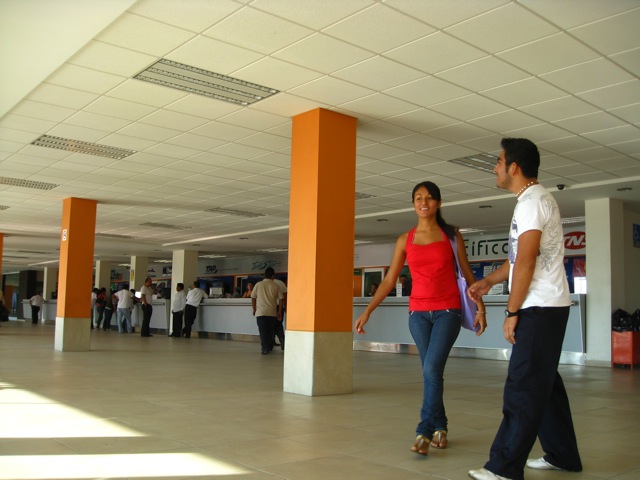
Bus Terminal in Tepic, Nayarit

My daughter came south to meet me at my parent's home and we took an overnight coach to the city where she works. The inter-city bus system in Mexico is excellent and very reasonable in price. We received a sandwich and drink when we boarded and the seats were comfortable recliners. Two washrooms were in the back of the bus and no stops were made for passengers to stretch during the 15 hour trip. (We were stopped several times at security checkpoints) The bus travelled through the mountains to the coast at Mazatlan and then ascended 10,000 feet from sea level along the road to Durango known as the Devil's Spine. It was dark and foggy and for a while I watched the bus pass slower trucks on steep curves using a radar system to detect approaching vehicles. Then I took some Gravol and slept. Three movies played during the first few hours of the trip;- Angels and Demons, The Omen, and In Hell. It was a night to remember (or forget), but we arrived safely at our destination.

Our overnight coach on the right

The only time I was really concerned about transportation was at 5AM on the morning we left for Canada. We had a 40 minute drive in the infamous minivan and it was obvious that the alternator was on its last legs as the lights flickered on the dark ride to the airport. I really did not want to miss our 7AM flight. But once again, we arrived safely.
We have many, many rules in place in Canada to protect ourselves and others. Some would say we are over-regulated by the government. A visitor needs to be aware of our laws before they enter the country and we need to be prepared for possible risks when visiting another nation. I do hope Cody LeCompte is able to come home soon but the cost has been very high for he and his family.

Next day post script: I was reading Esther Garvi's blog this morning and interestingly, she posted this picture of a well loaded truck in Niger. This truck appears to need servicing as well.

A well-filled passenger truck- photo by Maurice Saley

El transporte-Transportation

Sunday, July 25, 2010

Working in sugar cane fields in Nayarit, Mexico

Gaelyn wrote a comment on the last post about her observations when she visited Mexico.

"Rich indeed! Every where I traveled in Mexico the people were so much richer than most Americans, strong family, gorgeous surroundings, happy and full of life..."

I was talking to one of our physicians at the hospital about my trip to Mexico. He had worked in the southern part of the country in the past and I asked him if that particular area was poor. His impression was similar to Gaelyn's and he said that while the people did not have many material possessions, they had all they needed for health and happiness.

Fatima and her new puppy

The University of Michigan's World Values Surveys (WVS) has compiled data on the happiest countries in the world for over twenty years. Their results are considered the most authoritative by happiness researchers. (source)

The winners were
1. Nigeria
2. Mexico
3. Venezuela
4. El Salvador
5. Puerto Rico
with Canada at #10 and America at #15.

Other studies have shown that the happiest people surround themselves with family and friends, don't care about accumulating material goods, find pleasure in their daily activities and forgive easily. Mexico has economic, security, social and political challenges but many people I met, while poor by our standards, were content and happy.


There were incidents of drug-related violence in the city of Tepic recently and police and army checkpoints were set up along the roadways. Thousands of killings have been reported in Mexico since President Felipe Calderón came into power in 2006 and began an anti-drug campaign against cartels which traffic illegal drugs into America. Most of the victims are members of organized crime groups who are fighting for control of trafficking routes. Police, members of the judiciary and journalists have also been targeted. I generally avoided eye contact and photographs in patrolled areas, but the policeman above posed proudly for me as my dad purchased pineapples from the back of a pick up truck in the village. Life goes on as usual for the average citizen and I sensed little anxiety or fear on the streets.

Tortilleria in San Pedro, Coahuila

My daughter buys tortillas at this little business near her home. It was hot outside and even hotter inside the small structure. Most people I know in Canada would complain about working in these conditions. Visiting a poorer nation (not just a tourist resort) always makes me appreciate the exceptional standard of living I enjoy and helps me value the non-material sources of happiness in my everyday life.

Toddler in the village of San Luis de Lozada

Many Mexicans long for the "American" lifestyle and relentless messages in popular media are influencing younger generations to value material things more than ever before. I hope this little girl grows up to value the traditional aspects of her culture which cannot be traded for money and wealth.

Felicidad- Happiness

Thursday, July 22, 2010


A small town called Camichin de Juaja is less than a kilometre from the family property in Mexico. It is typical Mexican community with rows of low adobe homes in streets around the main zócalo or town square. To the average American or Canadian it appears very poor but what is a true measure of wealth? Beautiful orchids bloomed in the courtyard of a home where a woman stood outside scrubbing her laundry by hand on a stone wash board. My father asked if I could enter the gate to take a picture of the flowers and she graciously let me in.


My brother Philip pointed out the star cactus flowers blooming at the front of his house. They smell like carrion and attract flies but I did not personally try to find out if this is true. Regardless of the plant's diet, the blooms were beautiful and unusual.


This Tabachin tree flowered outside the window of the guest room. I loved the vibrant red colour and the tree attracted many birds and butterflies. Mom had willed it into holding its blooms until I had seen it but by the time I left the rains had caused most of the flowers to fall to the ground.

Bougainvillea and Crepe Myrtle (lower right)

I put more of the many pictures I took into these collages and all but one, the yellow tree in the lower set, were taken on the family property. It was always interesting to walk around the grounds to see the many flowers and fruit trees.

Passion Flower, Ornamental Banana flower
Edible banana flower, Trumpet Tree (tabebuia serratifolia)

Las Flores- The Flowers

Sunday, July 18, 2010

I arrived in Mexico the same week the summer rains started in the states of Jalisco and Nayarit. Subtropical climates with their dry and rainy seasons are far different than our weather in Canada where six weeks without rain is a significant drought. Here it rains only in the summertime, from about June to September which coincides with hurricane seasons on both the Atlantic and Pacific coasts.

My parents' home at the start of the rains. Things are much greener now.

The three hour drive from the airport in Guadalajara to the home of my family near Tepic was very wet as we drove up mountains into the clouds and then down in valleys with lightning and rain descending on the slopes above us. The temperatures in Tepic were hot and the humidity very high.

Early morning...This is the same direction as the sunset picture below

Morning mists rose from the ground until they were burned off by the sun. The surrounding sugar cane fields had been harvested and with the rains, the brown landscape became greener every day. My brother has planted hundreds of trees and plants on their five acre property and the flowers were beautiful.


Very early one morning, just as the sun was rising, I walked outside after a thunderstorm and a full rainbow stretched across the valley over the city of Tepic. Ten minutes later it was gone but it was a great way to start a new day.

San Pedro, Coahuila

Our daughter lives in the north of Mexico in the state of Coahuila. The area is part of the Chihuahuan Desert and rain may not fall for a year or more. Dust storms are more common than rainstorms. It was very hot here too, and the air so dry you didn't sweat but just evaporated. One day at noon, while we were at the main town square, a downpour started and most of the children who were gathered for a festival ran for shelter. But a few ran happily in the warm rain which did cool the temperature significantly.


Clouds bring rain and they also create spectacular sunsets. I took far too many pictures of the evening light over the mountains in front of my parents' house but each moment was different and better than the last.

In Canada we often experience dreary, grey, rainy weather for days on end. The rain in Mexico was present each day but the sun always came out when the storms moved away.

Sing to the LORD with thanksgiving;
Sing praises on the harp to our God,
Who covers the heavens with clouds,
Who prepares rain for the earth,
Who makes grass to grow on the mountains.

Psalm 147:7-8

Las Lluvias- The Rains

Sunday, July 11, 2010


It was the summer of 1972 when Grandma decided to take me on a summer road trip along the Bruce Peninsula in southern Ontario. I was a newly licensed driver and she gave me the wheel of the car for the entire trip which was a great confidence booster for a teenager. I dared not go above 50 mph on the highway (Ontario had not yet converted to metric measures) and Grandma made me pull over on the shoulder if cars behind were anxious to pass us. Our destination was Tobermory at the northern tip of the peninsula and we planned to board the ferry to Manitoulin Island. At that time the M.S. Norgoma, a 190 foot vessel, carried passengers to the docks at South Baymouth. We arrived and booked into a motel in Tobermory, but very windy weather prevented us from taking the boat across Georgian Bay for the next two days.

Young passengers on the Chi-Cheemaun

Today the Chi-Cheemaun, a much larger vessel, ferries vehicles and passengers both ways across the water from Highway 6 at Tobermory to the continuation of Highway 6 on the island. Last week I finally took the journey that Grandma and I missed almost 40 years ago. It seems impossible that so much time has passed since the summer I finished high school.

I returned from Mexico the day before we went north for our vacation. Mom had her first round of chemotherapy when I was there and endured a week of nasty side effects. She had her second round of treatment yesterday. Their home is situated in a beautiful area of the countryside in southwestern Mexico and I enjoyed the restful environment despite the circumstances around my visit.

Lighthouse on Cove Island

We do not know what the future holds and that is a good thing. A butterfly may live for days and its life is measured by moments. A bird may live a few years and its life is measured by weeks. A tree may live for hundreds of years with its life measured in decades. Our lives are a modest span that we measure in years. I couldn't help thinking as I spent time with Mom and Dad that they are living what my life may be in 20 years or so. And seeing how fast time has gone since that vacation with Grandma, those years may come before I am ready for them.

Perhaps life is best measured in "butterfly" moments, seizing pleasure and joy while releasing irritations and frustrations which drag us downward.

And Time Goes By